Why Paid Social Media Advertising Matters
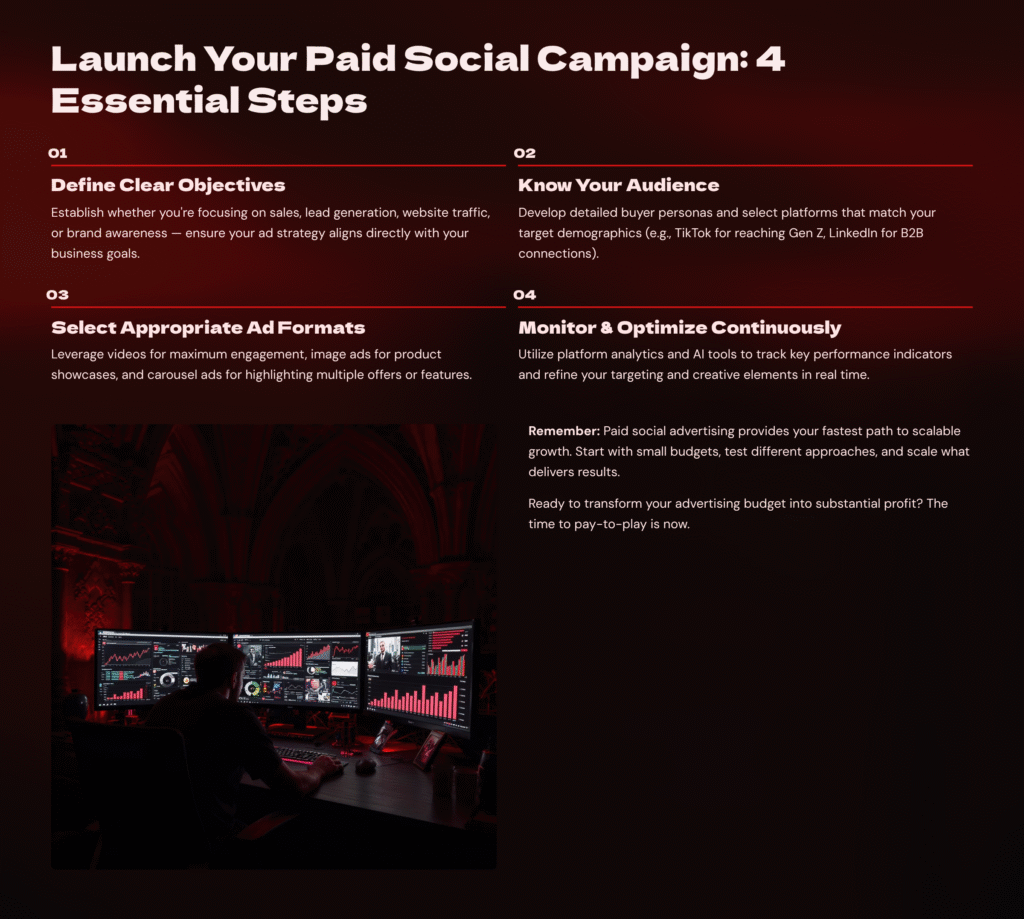
While organic social media builds trust and community, its reach is often limited by platform algorithms—only a small percentage of your followers may see your content. Paid social media advertising bridges this gap by allowing you to place your message directly in front of the exact people you want to reach, based on demographics, interests, behaviours, or previous interactions. Unlike traditional media advertising, paid social allows for hyper-targeting, real-time optimisation, and clear performance tracking. Platforms like Facebook, Instagram, LinkedIn, and TikTok give small businesses the ability to compete with larger brands using budget-friendly ad options.
For example, with just £5–£10 per day, you can reach thousands of potential customers, drive traffic to your website, collect leads, or sell products directly. Paid ads are especially powerful for time-sensitive campaigns such as launches, events, and promotions. Moreover, advertising can accelerate your marketing funnel by moving people from awareness to purchase faster, especially when combined with retargeting strategies. For entrepreneurs, learning paid advertising is like learning to drive—once you understand the mechanics, you gain freedom, speed, and control over your growth.
Understanding Campaign Objectives and Funnel Stages
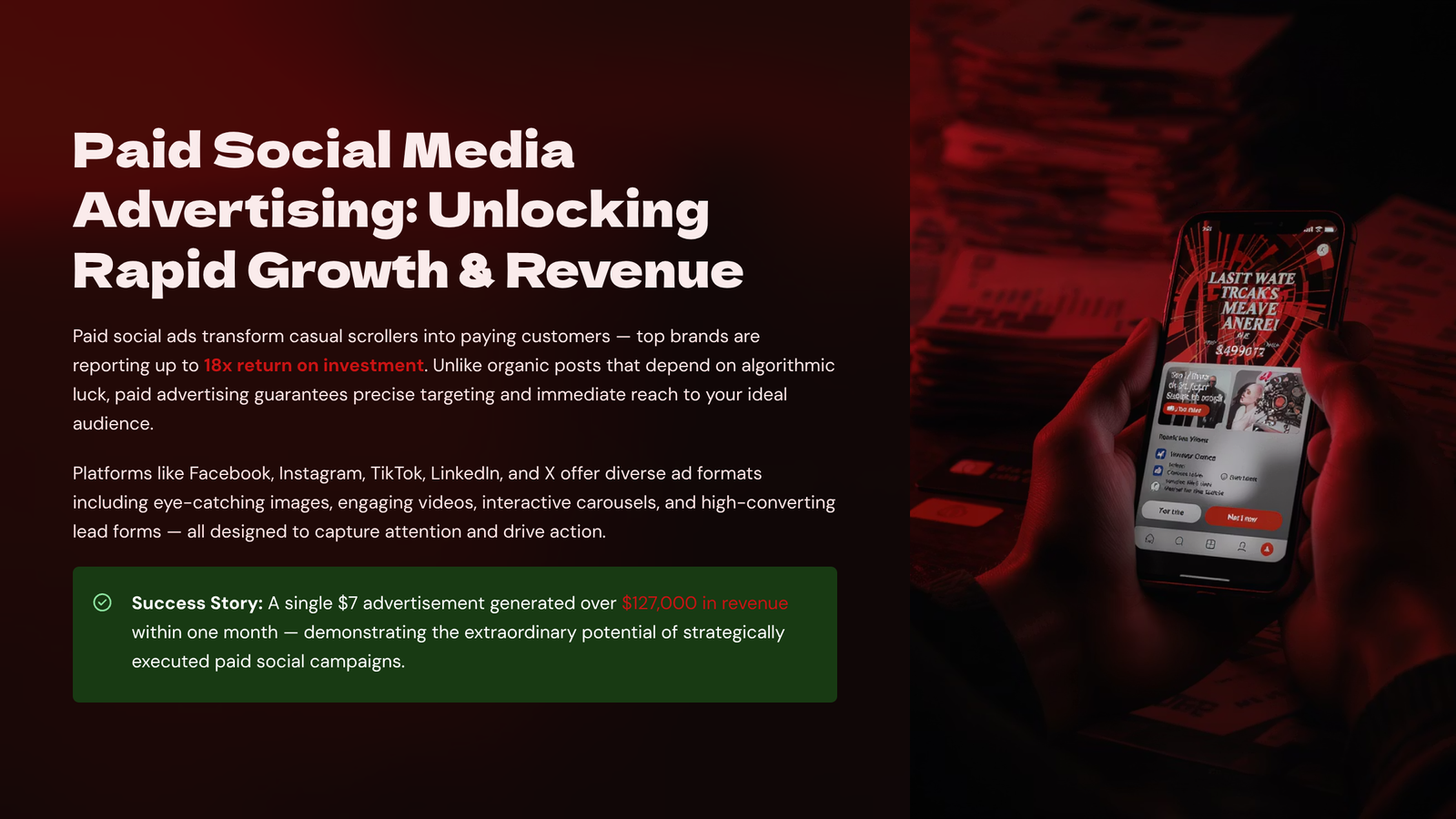
Before you run an ad, it’s critical to understand your goal—this determines which campaign objective you choose. Social ad platforms like Facebook Ads Manager or LinkedIn Campaign Manager provide multiple objectives that align with stages of the marketing funnel: awareness, consideration, and conversion. Awareness campaigns aim to increase visibility and reach (e.g., “brand awareness” or “video views”). Consideration campaigns focus on engagement, traffic, or lead generation (e.g., “traffic,” “engagement,” “lead forms,” or “messages”). Conversion campaigns are for sales, sign-ups, or purchases (e.g., “conversions,” “catalog sales”).
Choosing the wrong objective can waste budget—for example, running a “traffic” campaign when you really want leads may bring clicks but no action. Aligning your campaign with the customer journey ensures users see the right message at the right time. For a cold audience, start with an educational video ad. For warm leads, run an ad offering a free consultation. For hot prospects, show them testimonials and a limited-time offer. Your objective is not just a setting—it’s the strategic foundation of your campaign.
Targeting the Right Audience: Demographics, Interests, and Custom Audiences
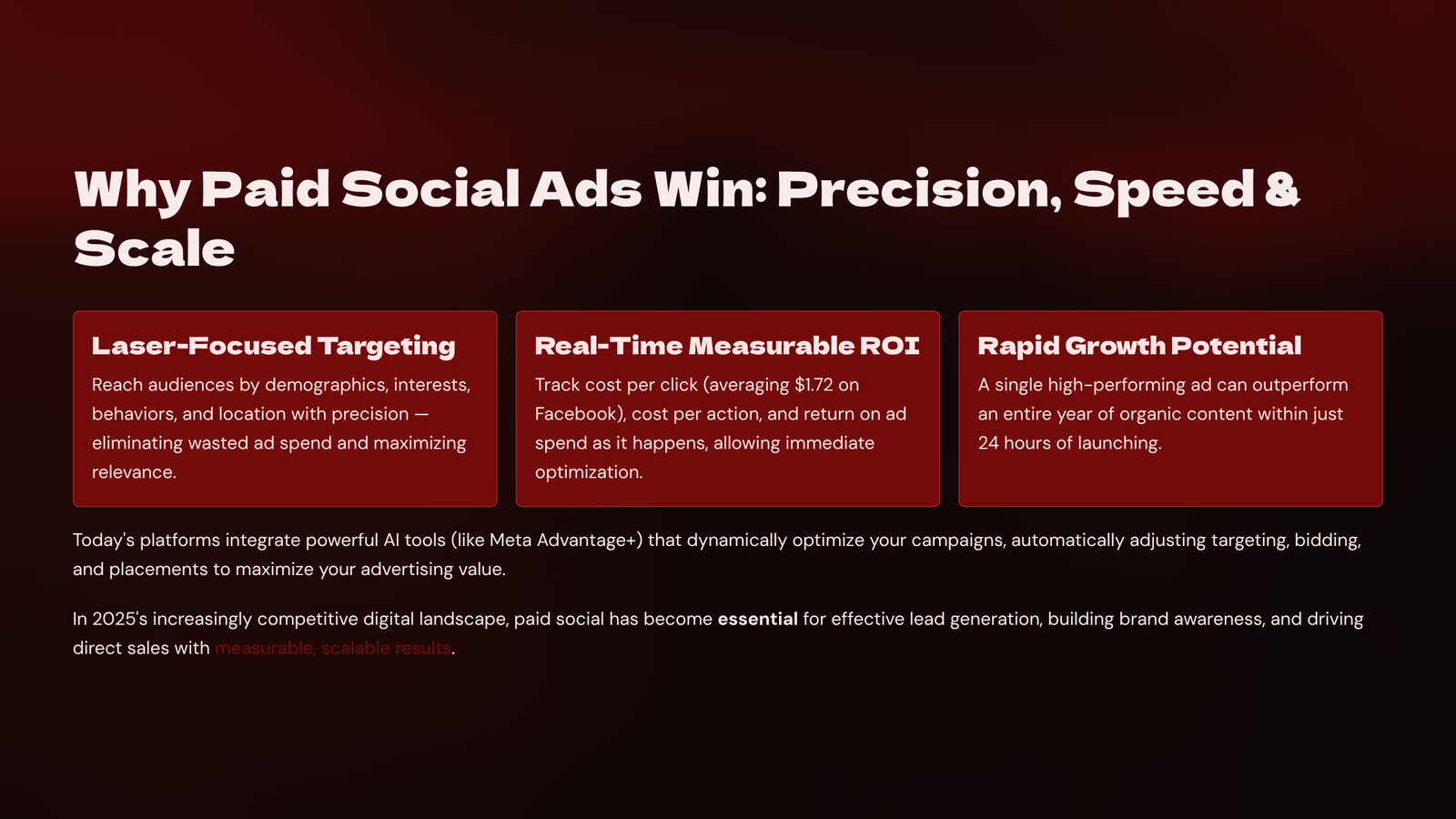
One of the most powerful features of paid social media is its advanced audience targeting capabilities. You can create audiences based on age, gender, location, language, job title, education, interests, online behaviour, and device usage. For example, you can target “women aged 35–50 in Manchester who follow fitness pages and shop online.” Facebook’s detailed targeting allows you to layer interests with behaviours, while LinkedIn allows targeting by company size, job role, and seniority—ideal for B2B. In addition to saved audiences, platforms allow custom audiences—for example, retargeting people who visited your website, watched 75% of a video, or engaged with your posts. Even more powerful are lookalike audiences—automatically generated audiences that resemble your best customers. These are incredibly useful for scaling. Proper targeting ensures your ads reach people who are most likely to care and convert, increasing ROI and reducing wasted spend. Testing multiple audiences with the same ad creative can reveal which segment performs best. Over time, you build a data-rich picture of your ideal customer and how to reach them predictably.
Crafting Irresistible Ad Creatives and Copy
The success of a paid ad depends heavily on two things: the creative (the visual or video) and the copy (the written message). Your ad needs to stop users mid-scroll, spark curiosity, communicate value, and drive action—all within seconds. The visual should be high-quality, relevant, and emotionally engaging. Videos under 30 seconds generally perform better than longer ones, especially when subtitled for silent viewing. Use bright colours, clear visuals, and minimal text to grab attention. Your ad copy should follow a proven structure: hook, value proposition, social proof, and CTA (call to action). For example: “Tired of wasting hours on spreadsheets? Our automation tool helps you save 10+ hours/week. 1,000+ users love it. Try it free for 14 days.” Use direct language, emotional triggers (fear of missing out, curiosity, relief), and urgency (limited-time offer). Match the tone of your audience—professional for LinkedIn, conversational or witty for Instagram. The best-performing ads are not just persuasive—they are aligned with the mindset of the viewer and the stage of the funnel. Test multiple versions to see what works: image vs video, short vs long copy, humour vs direct benefit.
Testing and Continuous Optimisation

A/B testing (or split testing) is the process of running multiple versions of an ad to see which one performs best. This is one of the greatest advantages of digital advertising—you don’t have to guess what works, you let the data decide. You can test different headlines, ad copy, visuals, CTAs, formats (carousel vs single image), or even audience segments.
For example, you might test two headlines: “Struggling with marketing?” vs “Grow your business with less stress.” Run them to the same audience and monitor the metrics: CTR (click-through rate), CPC (cost per click), CPM (cost per 1,000 views), and conversion rate.
Begin testing one variable at a time to isolate impact, then apply winning elements in new combinations. A/B testing also extends to landing pages—test layout, copy, form length, or headlines.
Use platform tools (Facebook A/B Test, LinkedIn Test Campaigns) or third-party tools like VWO and Google Optimize. Keep a testing journal to document results and insights. Over time, these small, data-driven tweaks can significantly improve your ad performance, lower costs, and increase ROI.
Analysing Performance and Scaling Winning Ads
After running your ads for a few days or weeks, it’s crucial to analyse their performance and decide whether to pause, refine, or scale. Start by reviewing metrics such as reach, impressions, CTR, CPC, CPM, conversion rate, and ROAS (Return on Ad Spend). A high CTR with low conversions may suggest weak landing page or misaligned messaging. A low CTR with high impressions suggests your creative isn’t compelling enough. Use breakdown reports to analyse performance by age, gender, device, time of day, or placement. Identify your top-performing ad sets—those with the best conversion and cost metrics—and increase their budget gradually (10–20% every few days) to avoid shocking the algorithm.
Pause underperforming ads to reallocate budget to winners. Consider scaling horizontally by duplicating successful ads and testing them with new audiences. Alternatively, scale vertically by increasing budgets or extending to new platforms. Scaling is about balancing performance and cost efficiency—never scale an ad just because it looks good; scale what the data confirms. The goal is to build a predictable, repeatable system that turns ad spend into consistent revenue.